Analytics · Prescriptive
Price Optimization
Turn your transaction history into segment-aware pricing you can defend, modeling how demand and willingness to pay respond before any list price changes, so you protect margin without eroding loyalty or conversion.
What it does
Tune pricing to demand and competitor activity.
Elasticity by segment
We model how demand responds to price across products, channels, and segments, so each move reflects real willingness to pay rather than a flat list change.
Recommended price with confidence
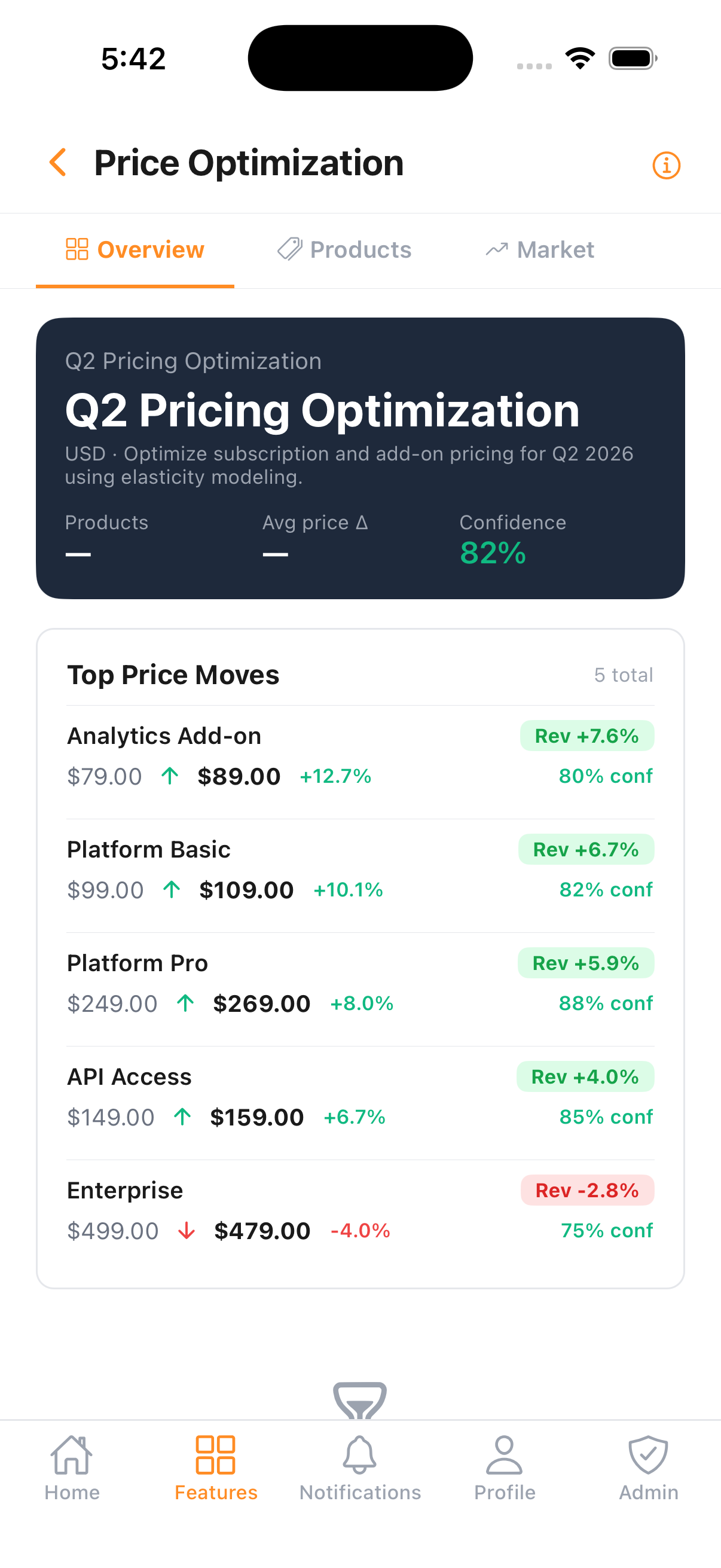
Every SKU gets a recommended price, expected revenue and margin change, and a confidence score, so teams know which moves are safe to publish.
Guardrails and governance
Floors, ceilings, and approval rules keep recommendations inside limits finance and customer-facing teams trust, flagging large single-SKU moves before they reach a touchpoint.
Scenario and promo testing
Simulate discount depths, bundles, and competitive responses against revenue, conversion, and retention before committing, so promotions support CSAT instead of training customers to wait.
How it works
Define guardrails
Align with commercial, finance, and customer teams on margin, growth, and retention targets, plus the floors, ceilings, and rules pricing must respect.
Integrate signals
Connect transaction history, customer segments, demand patterns, and competitive and cost data into one consistent view per product and segment.
Model elasticity
Build elasticity and optimization models that quantify willingness to pay and forecast revenue, margin, and conversion impact for each price option.
Simulate and validate
Stress-test scenarios, promotions, and competitive responses to understand risk and refine recommendations before anything reaches a customer.
Deploy and monitor
Roll out with playbooks, dashboards, and run history, so teams track realized price, revenue, and retention effects and iterate with confidence.
Powered by the Hub
Run it continuously, on web and mobile
- Unified pricing, transaction, and customer dataset
- Segment and product-level pricing analysis
- Scenario modeling across pricing strategies
- Competitive and demand trend monitoring
- Continuous pricing performance tracking
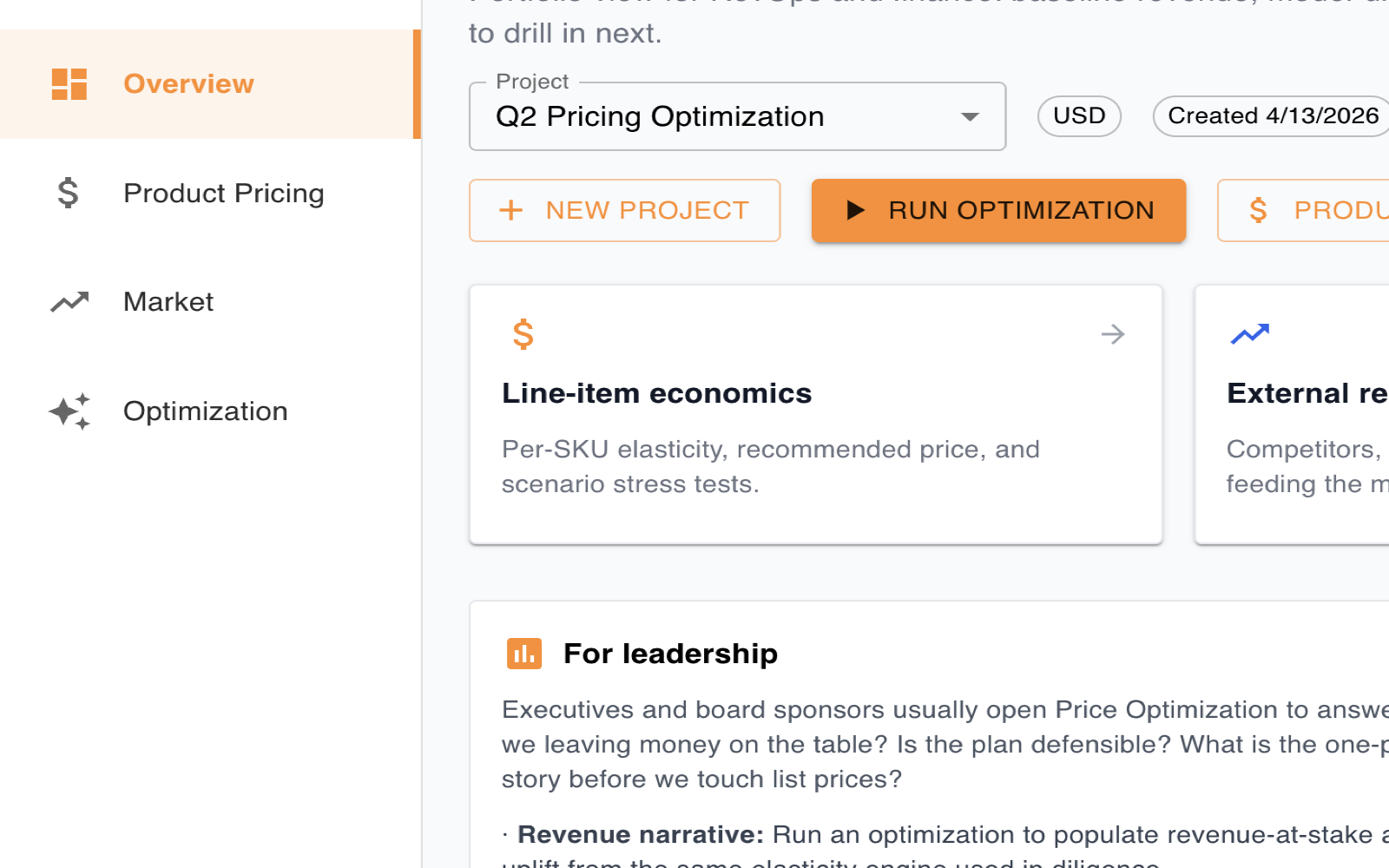
What you get

Recommended price by SKU
Each product’s recommended price, ranked by the revenue at stake in the move.

Portfolio revenue impact
The headline of the latest run: modeled revenue lift versus baseline and the average price move.

Elasticity distribution
How demand sensitivity distributes across SKUs, so room to move concentrates where it is safe.

Promotional scenarios
Discount depths scored on modeled revenue and margin, so teams pick offers that hold profitability.
Market reality
Why this matters now
Common
questions
What is Price Optimization? +
It uses demand, segment, and competitive signals to recommend prices, balancing revenue and conversion within clear governance, so your team can defend every move.
How is elasticity used? +
We model how demand responds to price changes across products, segments, and channels, which supports smarter adjustments and scenario planning before any change ships.
Who is it for? +
Pricing, revenue management, and commercial leaders in subscription, travel, retail, or any dynamic market, with Customer Success in the loop to protect loyalty.
How does it improve profitability? +
By aligning prices to demand and competition, you capture margin and volume that static pricing leaves on the table, and the model forecasts the impact before you commit.