Customer Lifetime Value (CLV) Modeling
Estimate the future value of every customer so you can invest where growth and profitability are highest, aligning acquisition, retention, and account strategy to predicted lifetime value rather than treating all customers the same.
Predict long-term value to focus retention.
Predicted lifetime value
We model predicted CLV per customer and account across a chosen horizon, blending transactions, engagement, and lifecycle behavior into a per-customer revenue forecast you can plan against.
Value-based segments
Customers are grouped into value tiers and RFM segments such as champions, loyalists, and at-risk, so you can tailor journeys and outreach to each cohort.
Unit economics and CLV-to-CAC
We pair predicted value with cost to serve and acquisition spend to surface CLV-to-CAC ratio and return on retention, so budget follows profitability.
Forecasts and scenarios
Scenario and cohort views show how shifts in retention, churn, or acquisition spend move long-term revenue, giving finance and growth a shared planning input.
A clear path from start to result
Collect signals
Aggregate transaction history, engagement, and lifecycle behavior alongside NPS, CSAT, and support touchpoints from your key systems.
Segment the base
Group customers into value tiers and RFM segments by spend, frequency, recency, tenure, and journey stage, so each cohort is addressable.
Model value
Predictive models estimate CLV, predicted annual revenue, and churn probability for each customer and segment over the chosen horizon.
Prioritize
Rank segments by profitability and growth potential, and flag high-value accounts carrying churn risk for focused retention effort.
Activate
Turn tiers into acquisition, retention, and win-back plays, and feed CLV forecasts into planning so spend tracks projected value.
Run it continuously, on web and mobile
- Predictive CLV modeling across accounts and segments
- Unified CX, transactional, and operational data
- High-value growth opportunity identification
- Portfolio and segment-level value monitoring
- Executive dashboards and mobile access
Deliverables you can act on

Value-based segments
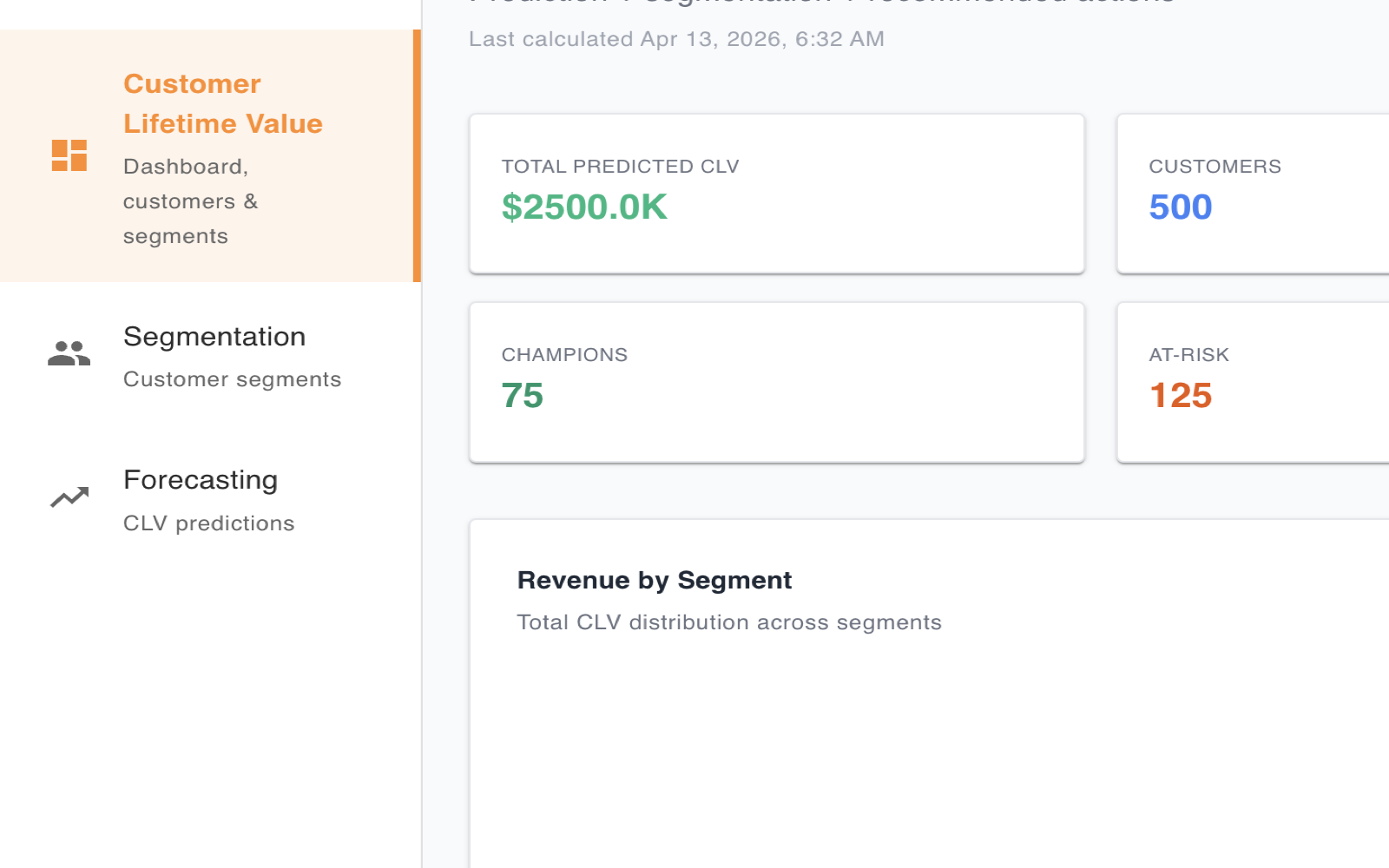
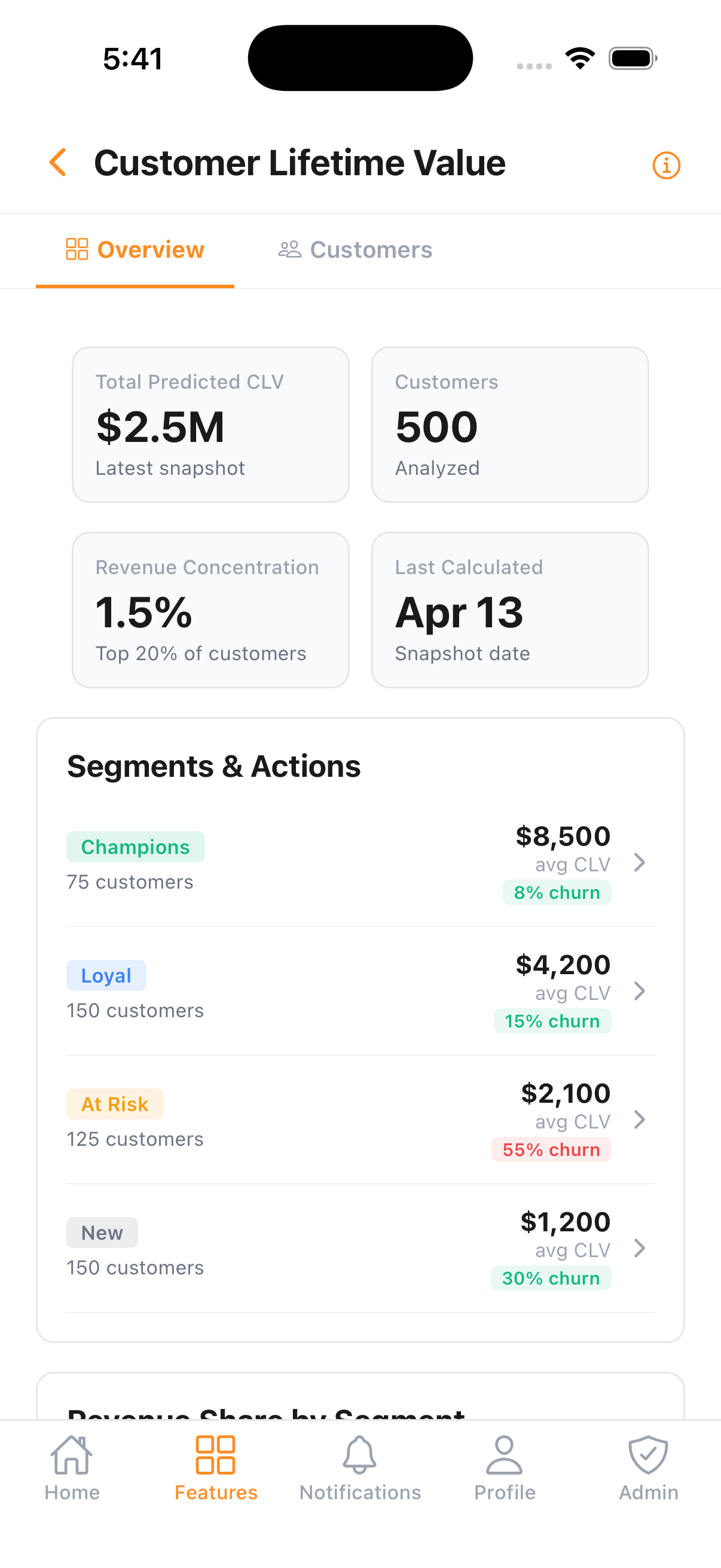
A ranked view of value-based segments by average CLV, mirroring the Segments table on the dashboard.

Portfolio CLV summary
Headline KPI cards for total predicted CLV and the share of value held by your top customers.

Top customers by CLV
Individual customers ranked by predicted lifetime value with churn risk flagged.

Revenue by segment
How total predicted CLV distributes across value tiers.
Last year’s spend is a poor guide to future value
Ranking customers by historical revenue rewards the past, not the trajectory. We forecast future value from CX, behavioral, and revenue signals so retention and acquisition spend goes where it pays off.
Historical revenue ranking
- Ranks customers by what they spent already
- Blind to trajectory and future potential
- No view of the drivers of long-term value
- Invests behind yesterday’s winners
Intellimark Lifetime Value
- Predicts future value, not just past revenue
- Forecasts future revenue per customer and segment
- Breaks value down by segment and tenure cohort
- Directs retention and upsell toward the highest-value segments
Verified against established practice and research: Bain & Company, Customer Lifetime Value · Zhang, Bradlow & Small, RFM to RFMC (Marketing Science, 2015) · McKinsey, Customer lifetime value: the customer compass
Why this matters now
6-14x
the lifetime value of a promoter compared with a detractor, depending on industry
Bain & CompanyCommon
questions
What is CLV modeling? +
CLV modeling predicts how much each customer is expected to spend over time using transactions, engagement, and lifecycle data, so you prioritize by expected long-term value.
How is it calculated? +
We build predictive models from your transaction history, engagement, and demographics, segment by cohort, product, or channel, and refresh it so priorities stay current.
Who uses it? +
Marketing, growth, commercial, and customer success leaders use CLV for acquisition ROI, retention strategy, and forecasting, tuned to your data and objectives.
How does it improve profitability? +
By aligning spend and effort to projected value, you under-invest less in low-value segments and more in high-value ones, supporting acquisition, retention, and planning.